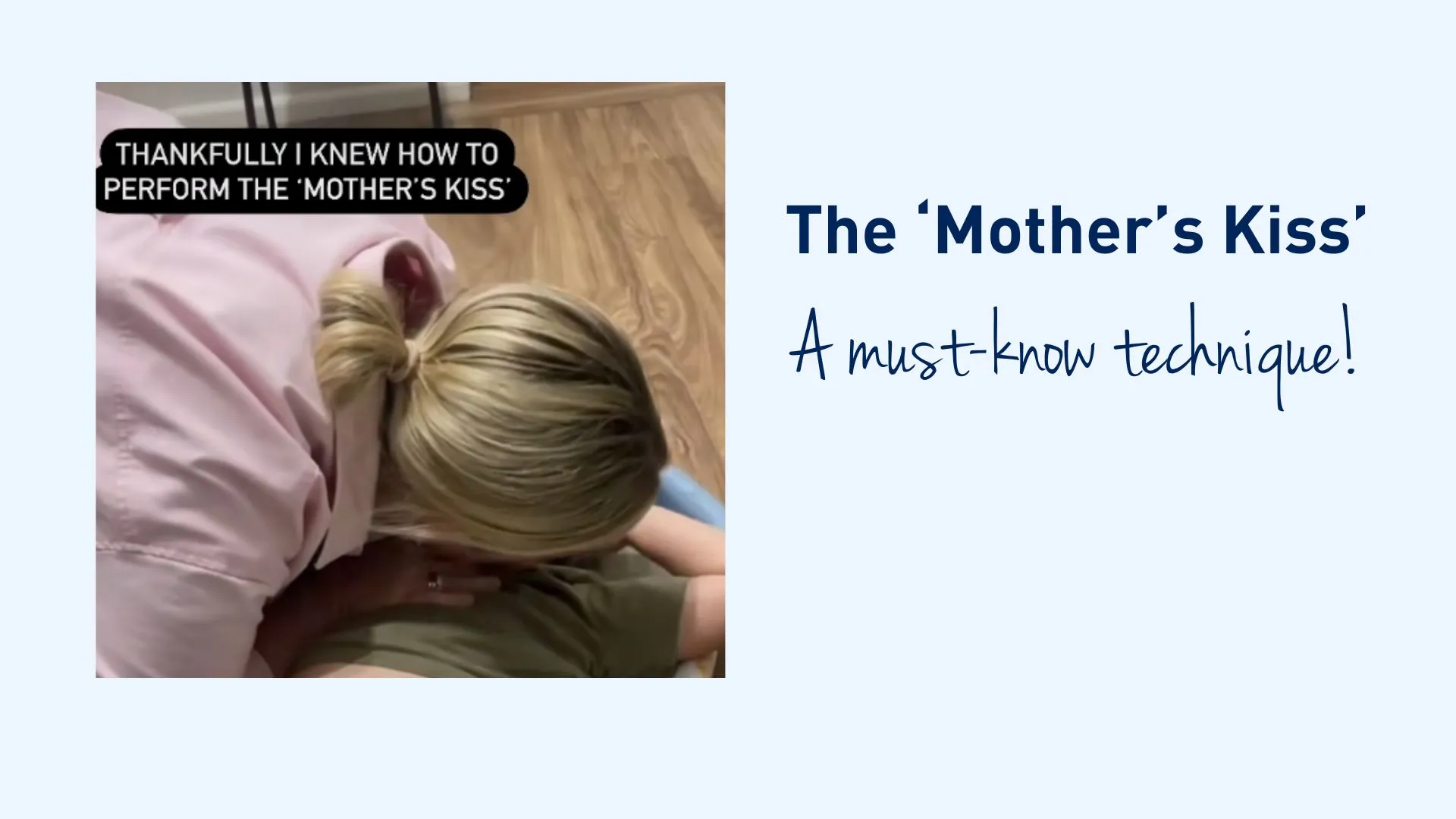
Do you know how to perform the ‘Mother’s Kiss’ (also known as the ‘Parent’s Kiss’) ♥️ ?
Knowing this tip has saved many of our parents/carers a hospital trip or two! You can see our recent reel which blew up on Facebook and shows the ‘Mother’s Kiss’ in action.
As we know kids put things up their noses. Beads. BluTac. Peas. Lego. Popcorn. The list is endless. That is why the ‘mother’s kiss’ is an invaluable tip that EVERY parent + carer needs to know about👇🏻
THE MOTHER’S KISS / PARENT’S KISS 💋
This works best with objects that are fully blocking the nostril.
The idea is that the parent or caregiver blows into the child’s mouth while blocking the clear nostril, creating positive pressure. The object will then hopefully be pushed out, likely with a torrent of snot!
Here are the steps:
1. Relax and reassure your child – explain to them you are going to give them a big kiss.
2. Block the clear nostril (ie the one that does NOT have the object in it) with your finger.
3. With a good seal, place your mouth over their mouth.
4. Breathe into their mouth, and as you feel a bit of resistance to your breath, give a short, sharp puff of air.
Hopefully, the object has popped out! You can repeat it, but make sure your child isn’t too distressed.
Never attempt to remove the object with tweezers etc, it can cause trauma and distress. If you can’t get it out with the Kiss method, you will need to seek medical help!
You can also heck out our reel demonstrating the mother’s kiss for a step-by-step demo.
References:
Baranowski, K., Sinha, V. and Aaraj, M.S.A. (last updated July 3 2023) Nasal foreign body – statpearls – NCBI bookshelf. Available at: https://www.ncbi.nlm.nih.gov/books/NBK459279/ (Accessed: 23 October 2023).
Cook, S., Burton, M. and Glasziou, P. (2012) Efficacy and safety of the ‘Mother’s kiss’ technique: A systematic review of case reports and Case series, CMAJ : Canadian Medical Association journal = journal de l’Association medicale canadienne. Available at: https://www.ncbi.nlm.nih.gov/pmc/articles/PMC3503923/ (Accessed: 24 October 2023).