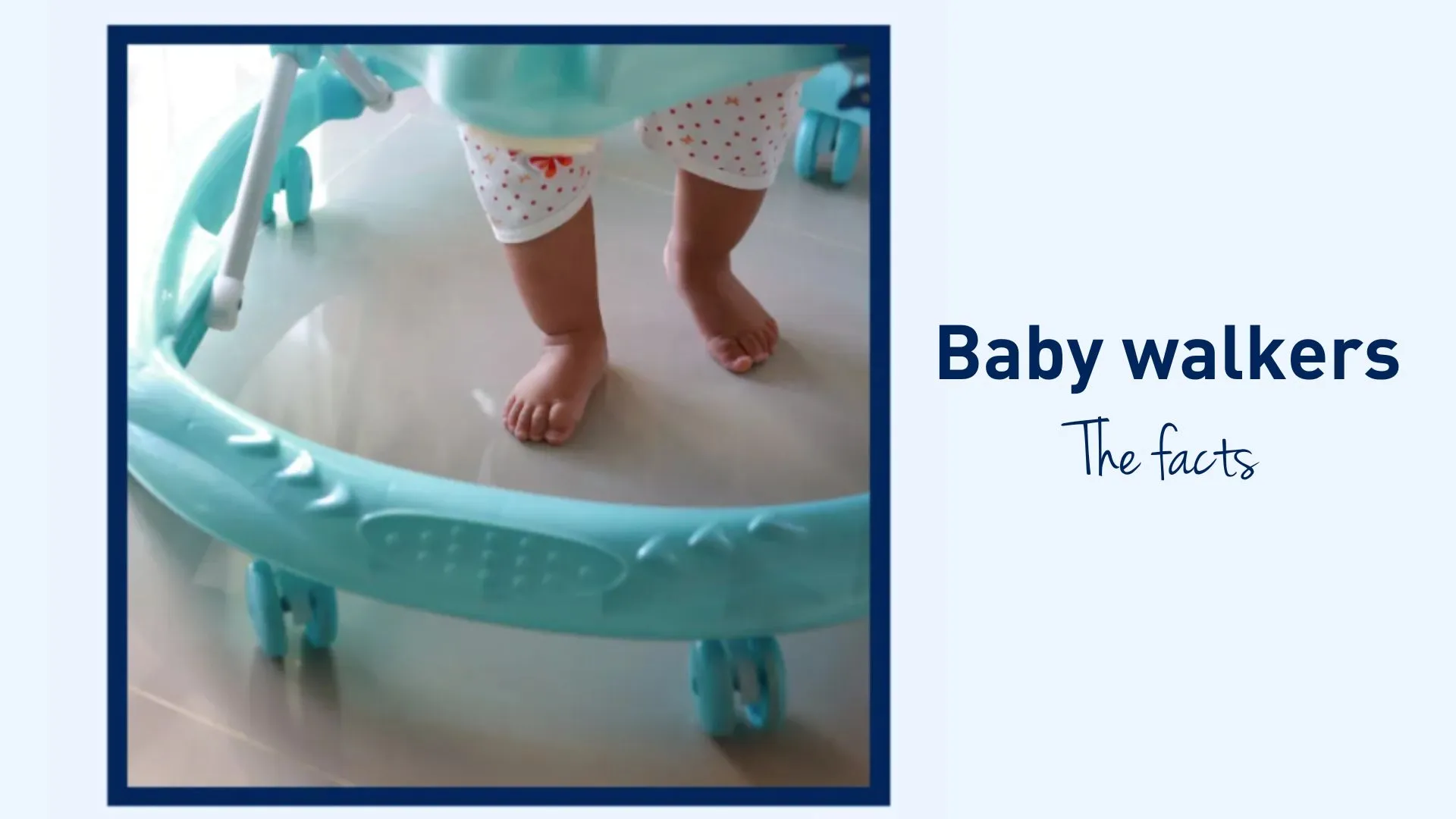
Should I use a baby walker?

Many parents believe that baby walkers encourage babies to learn to walk faster. This is actually a myth!

Many parents believe that baby walkers encourage babies to learn to walk faster. This is actually a myth!


Did you know that not only are baby walkers dangerous from an injury risk perspective but using a walker can delay independent walking?


Over 100 children visit emergency departments each year from incidents involving baby walkers, mainly due to head or facial injuries caused by falls.


Read the excerpt below from Dr. Claire McCarthy on the Harvard Health Publishing blog:

“Some parents buy them because they think that walkers help babies learn to walk faster. However, the opposite is true: using a walker can delay independent walking. That’s because learning to walk isn’t so much about learning to use your legs. It’s more about learning to pull to stand and then balance and take steps without support. When babies are plopped into walkers, they don’t learn any of that. They learn it by being put on the floor with something they can pull up on, like a couch or a caregiver.”Dr Claire McCarthy MD

Claire McCarthy, M. (2018) Parents: Don’t use a baby walker, Harvard Health. Available at: https://www.health.harvard.edu/blog/parents-dont-use-a-baby-walker-2018092714895#:~:text=Walkers%20can%20give%20caregivers%20a,isn’t%20worth%20the%20risk. (Accessed: 22 August 2023).

Product Safety Australia recommends the following if you do choose to use a baby walker:

  • Follow the manufacturer’s instructions carefully.
  • Always supervise your child in a baby walker. They should always be within reach of an adult who can prevent them from accessing hazardous areas.
  • Ensure the baby walker is only used on flat, even, and safe surfaces to avoid falling or tipping over.
  • Block off access to staircases, steps, kitchens, and fireplaces to prevent injuries from falls, burns, electrocution, or sharp objects.
  • Do not place any objects on the baby walker that could cause it to tip over.
  • Make sure your baby walker has the safety features required by the mandatory standard – see the video below from Product Safety Australia
  • Do not leave your child in the baby walker for longer than 15 minutes at a time. Overuse can lead to developmental delays when they are learning to walk.

Be aware of the risks of using baby walkers, and consider not using one at all. ♥️

Share the Post:

You May Also Like

The 8 ‘red flags’ for unwell babies and children.

When your little one is unwell in the middle of the night, it can be hard to know whether to wait it out or seek urgent help. Red flags are the signs that tell you — no waiting, no second-guessing. From breathing difficulties to your own gut instinct, here are the 8 warning signs every parent and carer should know.

Read More

Starting solids? Here’s how to introduce allergens safely, incuding updated guidelines.

Starting solids can feel exciting and overwhelming. With updated 2026 ASCIA guidelines on introducing allergen foods, many parents are wondering what’s changed and what it means for their baby. This practical, parent-friendly guide explains when to introduce common allergens like peanut and egg, how often to keep offering them, and what to do if you notice a reaction. We break down the latest advice so you can feel more confident introducing solids safely.

Read More